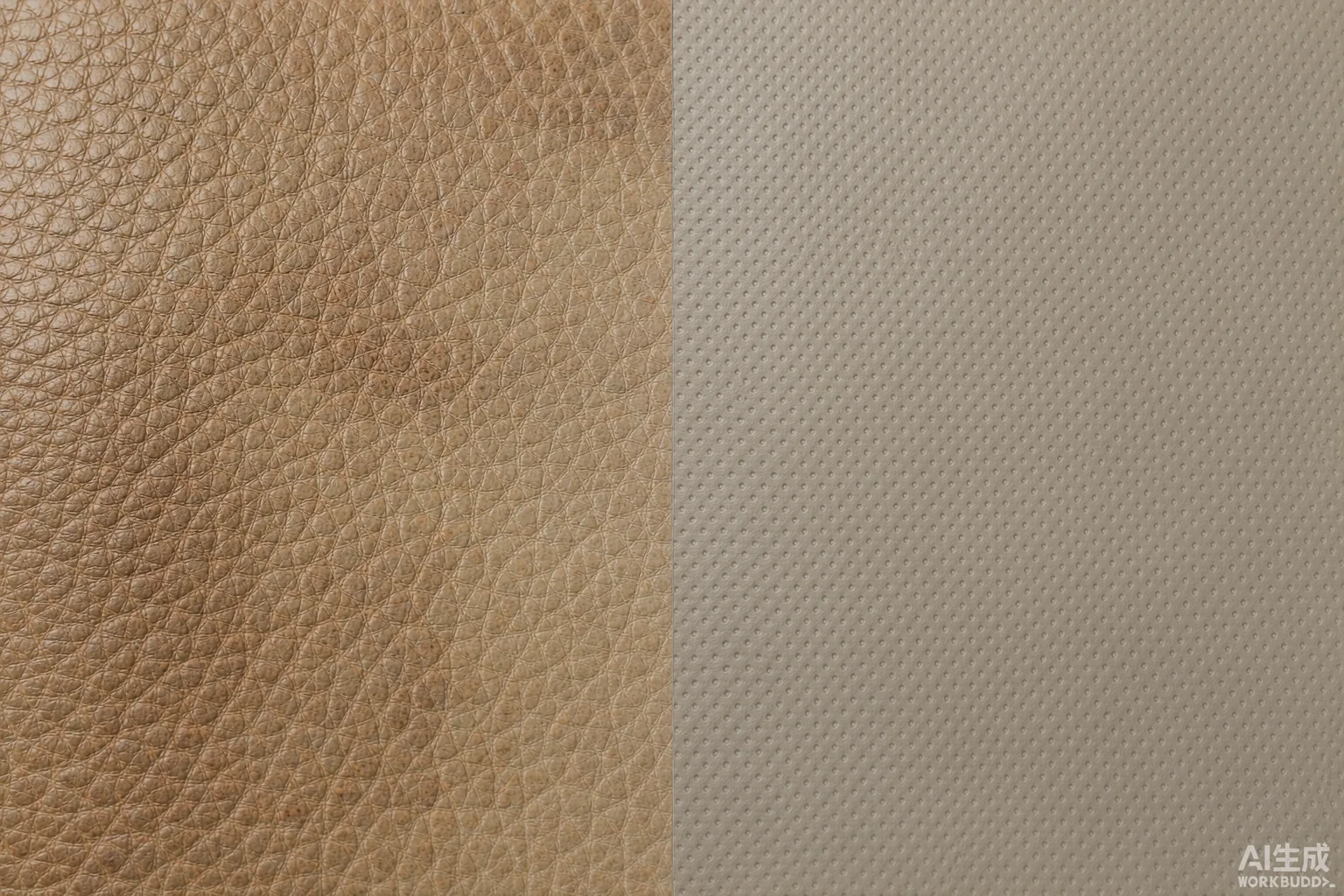
The short answer: real leather has irregular grain and pores, smells faintly sweet and animalic, feels warm to the touch, and its cut edges show fibrous texture. Faux leather has a perfectly repeating printed grain, smells of plastic or chemicals, feels cool and uniform, and its edges reveal a woven fabric backing.
You do not need to destroy anything to tell the difference. Several of these tests take two seconds and none of them require specialist equipment.
Seven tests that actually work
| Test | Real leather | Faux leather |
|---|---|---|
| 1. Look at the grain | Pores and marks vary across the surface; no two areas are identical. | The pattern repeats exactly, like a printed sheet. |
| 2. Smell it | Faint, warm, slightly sweet animalic smell. | Chemical, plastic or vinyl smell — or no smell at all. |
| 3. Feel the temperature | Warms quickly in your hand. | Stays cool; it is plastic. |
| 4. Press and release | Fine creases radiate from the pressure point, then relax. | Either no crease, or a crease that stays. |
| 5. Inspect the edge | Fibrous, suede-like, slightly ragged. | Clean cut revealing woven fabric or foam backing. |
| 6. Flex it | The surface grain changes as the leather bends. | The printed pattern stays rigid and unchanged. |
| 7. Check the back | Suede-like flesh side, or a finish on full grain. | Visible woven textile bonded to a coating. |
The two tests to skip
Online guides routinely recommend two tests that are unreliable and destructive.
The burn test
Burning real leather smells of hair and leaves ash; burning plastic smells acrid and melts. It works — but it destroys the item, and modern synthetic coatings can produce ambiguous results. Do not set fire to something you are trying to identify.
The water drop test
The idea is that leather absorbs water while plastic does not. In practice most finished leather is sealed to some degree, so a drop may sit on the surface for a while regardless. Meanwhile some faux leathers are made to be breathable and will absorb. The result tells you about the finish, not the material.
"Genuine leather" is not what you think it means
This is where most buyers get caught. The phrase sounds like a guarantee of quality, but in the grading system it is actually one of the lower tiers.
- Full grain: the top layer, uncorrected. Strongest, breathes, develops patina.
- Top grain: the top layer with the surface sanded to remove marks. More uniform, slightly less durable.
- "Genuine leather": usually made from the layers left after the top is split off, often coated and embossed to imitate grain.
- Bonded leather: scraps and dust mixed with adhesive and pressed onto a backing. Structurally the weakest.
All four are real leather in the sense that they come from a hide. That is why the phrase is legally accurate and still misleading — it tells you the material is animal, not that it is good.
Why the difference matters in practice
| Property | Real full-grain leather | Faux leather (PU/PVC) |
|---|---|---|
| Lifespan | Decades; improves with age | Typically 2–5 years before cracking or peeling |
| Failure mode | Wears, patinas, can be reconditioned | Coating peels and flakes; not repairable |
| Breathability | High | Low; can feel clammy |
| Weight | Denser for the same thickness | Lighter |
| Repairability | Can be cleaned, conditioned, restitched | Cannot be meaningfully restored |
The honest summary: faux leather has improved a great deal and is a legitimate choice on ethical or budget grounds. What it cannot do is age. It looks closest to new on day one and degrades from there, while real leather looks good on day one and gets better.
How to check before you buy
- Read the spec, not the marketing copy. Look for "full grain" or "top grain". Treat unqualified "genuine leather" as a prompt to ask a question.
- Ask where the hide comes from and how it was tanned. A maker who knows will answer in one sentence.
- Look at the edges in product photos. Butted, painted edges often signal a coated or split material; a maker proud of full grain usually shows the raw edge.
- Check the price against the material. Full-grain hides are expensive. A very low price is information.
Frequently asked questions
How can you tell if leather is real without damaging it?
Use the grain, smell, temperature and edge tests together. Look for irregular pores rather than a repeating print, a warm animalic smell rather than a chemical one, a surface that warms in your hand, and edges that look fibrous rather than like cut fabric.
Does real leather peel?
No. Peeling is a failure of a surface coating, which is characteristic of bonded leather and faux leather. Full-grain and top-grain leather wear, scuff and darken, but the surface does not flake off because there is no applied layer to separate.
Is "genuine leather" real leather?
Yes, it comes from an animal hide — but it is a low grade. It is usually made from the split layers beneath the top grain, then coated and embossed to imitate a better surface. It is real, but it will not perform like full grain.
Does faux leather last as long as real leather?
No. Polyurethane and PVC coatings typically crack or peel within two to five years of regular use, and cannot be restored once they fail. Full-grain leather can last decades and can be reconditioned along the way.
Why does real leather cost more?
Mainly the raw material. Full-grain hides are the most expensive part of the supply chain, and a maker using them cannot hide defects with a coating — so more of each hide is unusable. The cost is in the material and the waste, not the label.